Planned Preventive Maintenance Implementation

In modern and forward thinking businesses it has for some years been realised that prevention is better than cure and that proactive, rather than reactive management brings the best results for these businesses.

This is also true for managing the plant and machinery that all organisations use to produce their products or support their operations.

All machines require regular and effective planned maintenance to operate correctly and meet their design specifications. The consequences of ineffective planned maintenance can be huge in terms of profitability, personnel morale and management time.

Such consequences are often overlooked or miscalculated because machine breakdowns are not just a cause of lost time and potentially missed deadlines but have a direct affect on output, efficiency and thus profitability. Therefore, the importance of effective planned maintenance to reduce the occurrence of such incidents cannot be overstated.

Planned Preventative Maintenance and Strategic Maintenance Planning

The management of planned maintenance for single or for few machines is relatively simple. However, most organisations have many plant items and to correctly maintain these machines can be difficult or impossible without a formalised manual or Computerised Maintenance Management System (CMMS).

Strategic Maintenance Planning as specialists in modern Maintenance Strategy Development has a structured approach to implementing Planned Preventative Maintenance (PPM) projects and can help:

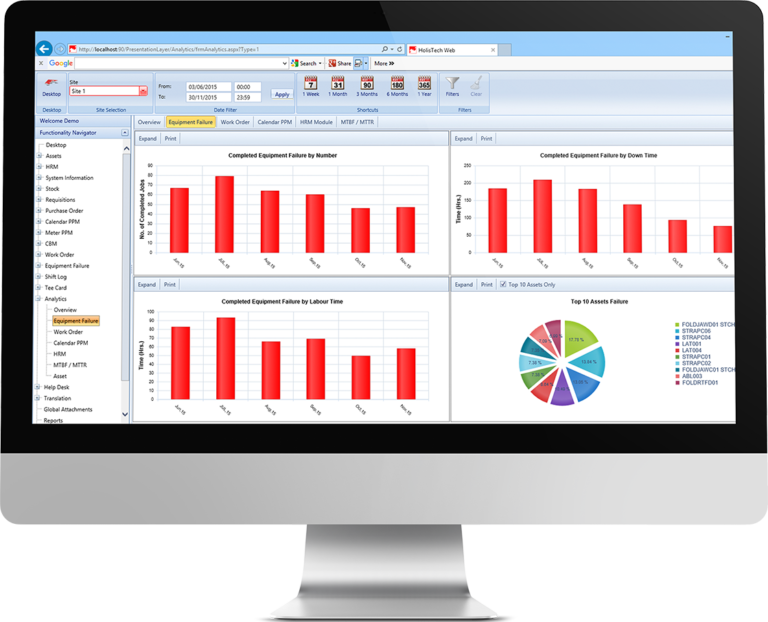
If deciding to use the HolisTech™ Computerised Maintenance Management Software (CMMS) our project management service can deliver a tried and trusted method which is 100% successful and provides a sound maintenance management system.

An outline of our methodology is illustrated below:

We ensure that our work fits with and enhances existing systems and that the client is briefed throughout the entire process and involved in all decisions, by following a structured & proven methodology.

Asset Register

The ‘Asset Register’ is a pre-requisite for a successful maintenance management system as it provides the base data for such a system.  Without a structured and effective Asset Register the foundations of both a PPM and a Stores Inventory Management system would be flawed. Completion of this work allows successful operation of the Asset Register and additional modules to include the Work Order, Help Desk, Condition Based Maintenance, Shift Log Control, Analytics and Equipment Failure modules of HolisTech™ and provides a solid groundwork for subsequent Planned Preventive Maintenance implementation.  The methodology utilised by SMP Ltd. to provide customers with a structured and effective Asset Register is illustrated in the ‘Asset Register Definition’ Process Realisation diagram below:

Planning

The ‘Planning Phase’ is where basic Asset Register requirements are defined and a basis for the detailed Asset Register definition is developed.  Elements of the phase include the following work steps:

  • High Level Spatial and Systemic Asset Register Definitions

Asset Register Definition by Position

Asset Register Definition by System

  • Existing Asset Data Assembly - Customer Engineering and Maintenance Functions usually retain considerable quantities of data concerning the Assets within their spheres of responsibility and it is important that any appropriate data is identified and retained for inclusion into a new CMMS.  This phase of work is for the SMP Ltd. assembly of any existing data identified by the customer ready for incorporation in later work stages.

Definition

The ‘Definition Phase’ is where the detail of the Asset Register is developed prior to being uploaded into the CMMS as a complete structure.  Elements of the phase include the following work steps:

  • Asset Maps - This element of work is for the SMP Ltd. generation of Asset Map
    Diagrams to cover each Asset included as part of the scope of work.  The work is designed to ensure that all items of equipment (i.e. Assets) are recorded and that none are missed.  Asset Maps are diagrams of Asset relationships which have a number of functions:
    • Ensuring an understanding of the Asset Relationships concerned
    • Ensuring that no Assets are missed from the Asset Register to be formed
    • Providing graphical material for future reference
    • Providing basic Asset detail recording media for subsequent Asset Listing

The maps are simply representations of a particular set of Asset relationships and as such do not deal with system throughputs and capacities (where appropriate).  Maps are generated within a MS Excel® format such that they can be electronically transferred and read by most business orientated desktop Personal Computers (PCs).

Process Map

  • Customer Review and Sign Off - This phase is the review and sign off of the generated Asset Maps and has the following objectives
  • Providing a means for customers to be involved in the process and to be satisfied that all available information is being incorporated
  • Providing a ‘sign-off’ stage for customer acceptance of the Assets to be included in subsequent work stages
  • Providing a means for SMP Ltd. to satisfy the requirements of the company ISO9001:2008 certification
  • Asset Listings - Once Asset Maps have been completed and customer sign-off has occurred, details of the Assets recorded will be transferred by SMP Ltd. to an ‘Asset Register Spreadsheet’ as an ‘Asset Listing’.  The details transferred to the spreadsheet initially provide a basic tabulated list of Assets, with ‘Associated Data’, and this is the starting point for the improvement of the Asset Register. 
  • Asset Register Relationships - The next stage of work is the definition of the ‘Asset Register Relationships’.  A well structured Asset Register provides interrelated coding relationships and these enable Assets to be sourced and identified easily via filtering within the CMMS and provide full reporting flexibility within the system.   
  • Asset Criticality Assessment - Criticality Assessment is the analysing of each Asset in terms of its potential to fail (i.e. fail to perform a designated function), the warning that is likely of failure and the effect such a failure may have on operational activity.  As part of the assessment each Main and Sub-Asset will be evaluated by SMP Ltd. and a ‘Criticality Assessment’ rating for each Asset and Sub-Asset will be recorded within the ‘Asset Register Spreadsheet’.

Completion

The ‘Completion Phase’ is where the Asset Register that has now been developed in Spreadsheet form is uploaded into the CMMS as a complete structure.  Elements of the phase include the following work steps:

  • Customer Review and Sign Off
  • Upload RFH to HolisTech™ - Once all Asset Register data has been collated within the spreadsheet and customer sign-off has occurred, it will be transferred by SMP Ltd. into the HolisTech™ CMMS.  This is a critical stage of the process as the accuracy and structure of the data will be pivotal in the eventual success and acceptance of the solution.
  • Completion Report - This work is for the SMP Ltd. completion of written project documentation.  This provides a completion of the Asset Register Definition project and provides a fully detailed ‘hard copy’ of all generated project data and also provides information on followed methodologies.

PPM Configuration

This phase of work is the ‘Implementation’ PPM Process and is the generation and scheduling against defined constraints of PPM Master Instructions for all Assets identified in the previously described ‘Asset Register Phase’.  Appropriate constraints on a successful PPM Regime are also considered during this work.  The methodology utilised by SMP Ltd. to provide customers with a structured and effective PPM Regime is illustrated in the diagram below:

The PPM Regime Development process will cover all Assets identified in the ‘Asset Register Definition’ phase.  Each of the work phases shown on the Process Realisation Flowchart are described in the sections below:

Planning

The ‘Planning Phase’ is where the primary research for the development of the PPM Regime is conducted.  Elements of the phase include the following work steps:

  • Existing Site PPM Data – SMP Ltd. will utilise any existing PPM information and incorporate it into the new regime to be defined where relevant.
  • Original Equipment Manufacturer Information - During this work element any available Original Equipment Manufacturer (OEM) information that is relevant to the Assets to be covered by the PPM regime will be identified and assembled by SMP Ltd. ready for use in the ‘Development Phase’ (described below).  OEM information is available from a variety of sources:
  • On-site electronic and hard-copy Original Equipment Manufacturer (OEM) manuals
  • OEM and associated company web-sites and electronic sources (where available)
  • SMP Ltd. proprietary information from the company’s many other implementation projects (the company has a library of PPM data covering thousands of Assets)
  • Maintenance Constraints - An understanding of maintenance constraints is imperative for the successful operation of an effective PPM regime.  The work also  includes collection and organisation of Engineering and Maintenance Function Human Resources information (including personnel names, shift patterns, known absence and training information) onto the HolisTech™ CMMS to provide a basis for scheduling PPM activity.

Development

The ‘Development Phase’ is the actual work to be completed for the PPM regime on the Asset Register is developed and defined.  This phase includes reference and inclusion of all required information that would be required to support actual work completion by appropriate customer personnel resources.  Elements of the phase include the following work steps:

  • Draft PPM Master Instruction Generation - The main element of work for the Development Phase is the SMP Ltd. generation of routine PPM MIs to cover Assets identified in the ‘Asset Register Phase’ and as defined by the results of the Criticality Assessment for HolisTech™ operation (i.e. PPM work is focussed onto the most critical Assets to ensure the most effective utilisation of Engineering and Maintenance Function resources).  The PPM MIs will need to include reference to:
  • Job steps to complete the required maintenance activity at a detail level to remove ambiguity and commensurate with the assessed Criticality of the Assets to be maintained
  • Required frequencies (i.e. build up of weekly, monthly, quarterly or 100 hours, 200 hours, 1000 hours etc. depending on task type)
  • Required human resources (in terms of work time, trade designation and staff numbers)
  • Tools and spare parts required for completing the job steps (note:  Full Kitting Lists are set up as part of the Stock Inventory system work as detailed elsewhere in this document)
  • Asset downtime required for task completion
  • The specific Assets particular PPM MIs are valid for
  • Any external references including electronic documents and information (HolisTech™ can be configured to automatically print out such documentation with the PPM MI as part of the PPM Regime as required)
  • Customer Review and Sign Off - This phase is the review and sign off of the generated PPM MIs by a designated representative.  Review and Sign-off has the following objectives: 
  • Providing a means for customers to be involved in the process and to be satisfied that all available information is being incorporated
  • Providing a ‘sign-off’ stage for customer acceptance of the PPM Master Instructions to be uploaded as a ‘live’ entity within the HolisTech™ CMMS
  • Providing a means for SMP Ltd. to satisfy the requirements of the company ISO9001:2008 certification
  • Upload to HolisTech™ - Once all PPM Master Instructions have been developed and customer sign-off has occurred, all PPM MIs will be transferred by SMP Ltd. into the HolisTech™ CMMS.  This is also a critical stage of the process as the aptness of the data will be pivotal in the eventual success and acceptance of the solution.
  • HolisTech™ CMMS Optional Risk Assessment Module Implementation (Optional)

Scheduling

The ‘Scheduling Phase’ is the finalisation work required to ensure a successful launch and ongoing Continuous Improvement of the implemented Asset Register and it’s supporting PPM Regime.  Elements of the phase include the following work steps:

  • Master Instruction Scheduling - Once all relevant PPM MIs have been input into the HolisTech™ CMMS they will be scheduled by SMP Ltd. against the identified Assets with account being taken of identified constraints (i.e. scheduling will be in line with pre-determined criteria) and will be in line with existing and previously scheduled work.  This task will help ensure the smooth and effective operation of the PPM regime.
  • Handover - The ‘Handover’ phase is where SMP Ltd. will ensure that customer personnel are familiar with the data entered in the system for the PPM Regime and are fully ready for system go-live.  This work relies completely on the designated customer personnel having completed HolisTech™ training commensurate with their required level of system interaction (this training would be either ‘System Administrator’ or ‘System User’ training as appropriate).
  • Completion Report - This work is for the SMP Ltd. completion of written project documentation.  This provides a completion of the PPM Regime Development project and provides a fully detailed ‘hard copy’ of all generated project data and also provides information on followed methodologies.

Continuous Improvement

The implemented CMMS will be successful with the ongoing support and involvement of engineering and maintenance functional personnel.

Essential and ongoing Continuous Improvement requirements include the following tasks:

  • Maintenance and updating of New Plant or alterations
  • System Maintenance and improvement
  • Audit & Review including Upgrading or Customisation

Overall Strategic Maintenance Planning can help YOUR organisation improve the effectiveness of your planned maintenance.

Click here to Contact SMP Ltd.


Featured Clients

Able Breads
ABR Foods
Aircelle (SAFRAN Group)
Airflow Streamlines Ltd.
Alcan
Alcoa
Alcoa CSI UK Ltd.
Allied Bakeries 8 UK Sites
An Post 4 Sites
Apollo Fire Detectors
Artex Blue Hawk Ltd.
Artex Rawplug
Askeys Ltd.
Associated Creameries
B&Q Plc.
B&W Loudspeakers
Baker Group of Companies
Baxenden Chemicals Ltd.
BCA
Bendicks (Mayfair)
Bostik 2 Sites
Bottle Green Drinks Co.
Braces Bakery 2 Sites
Bredero Shaw
Bristol Airport
Bristol Bending Services
British American Tobacco
Bryan Donkin Ltd.
Buckingham Foods
Burlington Slate
Burn Stewart Distillers Ltd.
Calsonic Climate Control Ltd.
Cereform Ltd.
Charnwood Foods
Chevron Texaco - East Midlands Airport
Cisco Systems Int BV.
Cisco Systems UK, Europe & Middle East
City Industrial Waste
Classic Courverture
Coates Electrographics
Coates Electrographics USA
College Gwent
Constellation Europe
Couldron Foods
County Confectionery
Coutts Packaging
DAC Plant
Dairy Crest Haverfordwest
Dalgety Arable
Dartington Foods Plc
Delphi Hungary
Dorset Chilled Foods
Dove Valley Ltd.
Dovecote Park
Dowty Engineered Seals
Ducal Ltd.
Eaton Aerospace
Eaton Hydraulics
Economatics (Industrial) Ltd.
Edinburgh City Council
Edrington Group 5 UK Sites
Element Six Production Ltd.
Elizabeth Shaw Ltd.
Encase Holding Ltd.
Encase Northern
Environmental Agency
Eternit
Euramax
Euro / DPC
Evode Ltd.
Exitech Ltd.
Explore Manufacturing
ExxonMobil 110 Sites Globally
Fenmarc Produce Ltd.
FFP Packaging Ltd.
Field Packaging Ltd.
Fortnum & Mason
Frank Wright Ltd.
Fusion Provida
Games Workshop
Gatwick Airport - Shell Aviation
GEO Adams & Co
GKN Driveshafts
GKN Hardy Spicer
The Cheese Company 4 Sites
GPS UK Ltd.
Grace Construction Products Ltd.
Greene King Brewing & Retailing
Greenway Lubricants Ltd.
Gulf News - Dubai 2 Sites
Hammonds Furniture Ltd.
Hazlewood Chilled Meals
Hazlewood Food Enterprises
Heathrow Airport - H.H.Op. Co.
Heraeus Electro-Nite
Hygrade Foods 2 UK Sites
Iceland Frozen Foods Plc
ID Data Systems Ltd.
Impact Control Systems Ltd.
J&A International
Johnson Controls
Kalmar
Kerry Aptunion
Kerry Foods 2 Sites
Kerry Ingredients
Kerrygold Company Ltd.
La Fornaia
Lafarge Lime
Lanstar Ltd.
Lawson Mardon Packaging
Lawson Mardon Star
Leicester Fire & Rescue Service
LG Philips
Linpac Storage Systems
Linread Automotive Plc.
Lion Foods Ltd.
Magners
Manor Bakeries Ltd.
Marchwood Power Ltd.
McCormick Group 2 UK Sites
Microvue Ltd.
Midland Meat Packers
Mixalloy Ltd.
Moss Plastic Parts Ltd.
Mowlem Technical Services
New Covent Garden Soup Co.
New Milton Sand & Ballast
Northern Foods
Norwich Corrugated Board Ltd 2 UK Sites
Novartis Consumer Health
On-Site Central Ltd.
Paarman Foods - South Africa
Pann Krisp
Parcelforce Coventry Hub
Parrs Confectionery
Paula Rosa Kitchens
Peartree Foods
Permabond
Permadoor
Peters Food Service
Plastic Omnium Automotive Ltd.
Plastics Manchester Ltd.
Polycast Ltd.
Poly-Flex Circuits Ltd.
Polyframe Trade
Poole Harbour Commissioners
Pork Farms Bowyers Ltd.
Pritex Ltd.
PVI Ltd.
Raven Manufacturing Ltd.
Regent GM Laboratories
Reichold UK Ltd.
REW Acton Ltd.
Reylon Ltd.
Richard Burbage Ltd.
Ricon Ltd.
RMH - Avana Bakeries
Roltech ASD.
Royal Doulton (UK) Ltd.
Royal Mail Group
S.A.T.O. (Greece)
S.H. Agricultural Engineers
SCA Packaging Ltd.
Scottish Power
Sekisui (UK) Ltd.
Shanks Chemical Services
Sheffield Care Trust
SIFE Unigate France
Sigma Aerospace Ltd.
Sola Optical (UK) Ltd.
Solo Europe
Spirax Sarco
St. Ivel Ltd.
Stansted Airport - Stansted Fuelling Co.
Stansted Airport - Stansted Into Plane Ltd.
Stanton Plc.
Steetley Dolomite
Still Material Handling Ltd.
T&B Group UK and Europe
Tarmac Topblock Ltd. 2 Sites
Telford Extrusions Ltd.
Telford Foods Ltd.
Harmsworth Press 11 Sites
The Royal Free Hospital
The Royal Mail
Thompson Plastics Group
Tangerine Confectionery 6 Sites
Tornado Pty
Trans World International
TRW Lucas Varity
Tuberex Ltd.
Tucker Fasteners
Tulip UK Ltd. 17 Sites
Tyco
UK AEA Jet Facility
Unigate Dairies Ltd.
Unigate EFG Plc UK and Europe
United Utilities Industrial
UYT
Vibro Meter
Vickers Industrial Products
Vickers Systems
Viking UK Gas
Viridor Waste Management 69 Sites
Visqueen Building Products
VP Automation
W.A. Turner
Watlow Ltd.
WBB Minerals
Whitworth Bros.
Wincanton Logistics
Winkhaus (UK) Ltd.
Woodbridge Foam 3 European Sites
Xyratex
Yoplait Dairy Crest

Latest News

Customer Testimonials
06th Feb 2012

A word from our customers..... See for youself why they count on us. "Thanks to the SMP team for all the team work with Viridor, SMP is a great example of a supplier to us that is seen...

Cereform move forward with HolisTech™ Horizon
16th Dec 2011

Cereform is part of AB Mauri, a division of Associated British Foods plc (http://www.cereform.co.uk). They are a market leader in ingredients for the baking industry and have now chosen to rol...

HolisTech™ On-Line Shop
01st Dec 2011

Shop Open Now – Watch Out for Special On-Line offers Strategic Maintenance Planning Ltd. has now added a Shop facility to the UK Web Site. We are currently populating the shelves...

Burn Stewart Distillers Ltd. - HolisTech™ Horizon
14th Nov 2011

Burn Stewart Distillers Ltd. is a fully integrated Scotch whisky producer and brand owner with three single malt whisky distilleries and a strong portfolio of Scotch whisky brands (http://www.burns...

Marchwood Power Ltd. - Criticality and Gap Analysis Project
14th Nov 2011

Strategic Maintenance Planning Ltd. is delighted to have secured a contract with Marchwood Power Ltd. to implement an Asset Criticality and Gap Analysis project. Neil Grant - Managing Director ...
© 2012 Strategic Maintenance Planning Ltd Site Map | Privacy Statement | Terms & Conditions Powered by Kontrolit